News
LATEST NEWS
- 01Ceramic vs stainless steel metering pump
- 02Benefits of ceramic plunger metering pumps
- 03Juchang Ceramic Plunger Metering Pump Valve - Products
- 04What is a ceramic metering pump used for
- 05Ceramic fluid metering pump working principle
- 06Application of Ceramic Liquid Metering Pumps and Drones
- 07Future Prospects of Ceramic Valves Under Low‑Carbon Economy - Juchang Precision
- 08Internationalization of Ceramic Valve Industry: The Need for Standardization | Shenzhen Juchang Precision Co., Ltd
- 09Four Major Advantages of New‑style Ceramic Valves|Breakthrough in Valve Industry
- 010Electric Valve: Types And Applications | Juchang Precision

Address:1st Floor, Zixiang Road, Pingshan District, Shenzhen, Guangdong Province
Zip Code: 518100
Phone: +86 13410681808
E-mail:juchang@zhmidi.com
News
HOMENews
Ceramic metering pump for lithium battery
2026-06-22 08:48:19 View:168Lithium battery manufacturing involves precise delivery of electrolyte, conductive slurry, additives and corrosive chemical solvents, which puts extremely strict demands on dosing equipment. Ceramic metering pumps stand out among all fluid pumps thanks to ultra-high precision, zero metal contamination, excellent corrosion resistance and long service life, becoming standard supporting equipment for lithium battery production lines.
Traditional stainless steel pumps easily cause metal ion pollution, precision attenuation and rapid wear when conveying battery chemicals, which will directly affect battery consistency and safety. This article fully introduces the advantages, core application links, selection points, maintenance and FAQs of ceramic metering pumps for lithium battery industry.
Table of Contents
1. Why lithium battery production needs ceramic metering pumps
Lithium battery electrolyte contains lithium salt, organic solvents and corrosive additives. Metal contact will produce heavy metal ions, triggering self-discharge, capacity decline and safety risks of finished batteries. At the same time, battery production requires micro-volume, repeated and consistent dosing to guarantee batch uniformity.
Disadvantages of metal pumps in battery workshop:
• Metal ion precipitation contaminates electrolyte
• Corroded by organic solvents leading to flow deviation
• Fast abrasion by abrasive slurry, frequent replacement
• Hard to maintain long-term ±0.1% dosing accuracy
All-ceramic wetted components perfectly solve the above pain points, matching the high purity, high precision and corrosion-resistant demands of new energy battery production.
2. Core advantages of ceramic pumps for lithium battery
Zero metal contamination
All flow parts are inert ceramic without metal composition; no ion dissolution, protecting electrolyte purity and battery performance stability.
Ultra-high stable precision
Long-term dosing accuracy up to ±0.1%, low thermal expansion material avoids flow drift caused by workshop temperature fluctuation, suitable for micro filling and proportional mixing.
Excellent chemical resistance
Resist lithium electrolyte, carbonate solvent, acid & alkali additives, no swelling, corrosion or decomposition.
Wear-resistant & long service life
High hardness ceramic withstands abrasive conductive slurry, service life 3–5 times longer than stainless steel plunger pumps, reducing production downtime.
3. Main application processes in lithium battery production
• Electrolyte filling: accurate quantitative injection into battery cells
• Slurry mixing: proportional delivery of binder, solvent and conductive agent
• Additive dosing: trace addition of film-forming, flame retardant additives
• Lab battery R&D: small-batch sample formulation and test filling
• Recycling liquid delivery: waste electrolyte recovery and separation
4. Key selection criteria for battery ceramic metering pumps
1. Flow range: match micro filling or large batch mixing demand
2. Working pressure: meet cell sealing filling pressure requirement
3. Wetted material: high-purity alumina / zirconia ceramic
4. Sealing material: FKM or PTFE resistant to organic solvent
5. Control mode: automatic flow adjustment linked to production line
6. Cleanability: easy full disassembly for CIP cleaning
5. Regular maintenance requirements for battery dosing pumps
Daily inspection → Check pipeline air leakage, abnormal noise and stable electrolyte output
Post-shutdown cleaning → Flush pump cavity with anhydrous solvent to prevent electrolyte crystallization
Weekly inspection → Check ceramic plunger surface for scratches, inspect seal aging
Monthly calibration → Test flow accuracy to keep error within ±0.1%
Quarterly replacement → Replace aging sealing rings to avoid electrolyte leakage
6. Common faults in battery production & solutions
Flow fluctuation during electrolyte filling → Air bubbles trapped inside pump; fully exhaust liquid pipeline before production
Electrolyte leakage at pump head → Seal corroded by solvent; replace solvent-resistant FKM seals
Dosing accuracy gradually drops → Ceramic valve seat stuck by electrolyte crystal; disassemble and clean all valve parts
Serious abrasion when conveying slurry → Add front-end filter to block hard particle impurities
7. Operation standards for electrolyte delivery
• Avoid long-term static storage of electrolyte inside pump cavity
• Complete solvent flushing once production batch finishes
• Control workshop humidity to prevent electrolyte hydrolysis crystallization
• Slow startup speed when filling cells to reduce liquid pulsation and bubble generation
• Separate dedicated pumps for different formulas to avoid cross-contamination of electrolyte
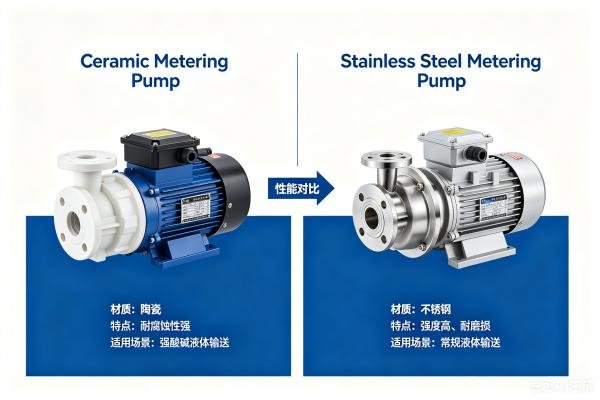
8. Performance comparison table: Ceramic vs Stainless Steel for battery
| Comparison Item | Ceramic Metering Pump | Stainless Steel Metering Pump |
|---|---|---|
| Metal Ion Precipitation | Zero contamination | Easy metal dissolution |
| Corrosion Resistance to Electrolyte | Excellent | Poor, easy to corrode |
| Long-term Dosing Precision | Stable ±0.1% | Gradual precision decline |
| Service Life with Slurry | 3–5 times longer | Short, frequent replacement |
| Suitability for Lithium Battery | First choice | Not recommended |
9. Frequently Asked Questions FAQ
Why cannot stainless steel pumps be used for lithium battery electrolyte filling?
Stainless steel reacts with lithium salt electrolyte to release metal ions, which will reduce battery cycle life and bring hidden safety hazards.
What cleaning liquid is suitable for ceramic pumps conveying electrolyte?
Anhydrous ethanol or matching carbonate solvent; do not use water to avoid electrolyte hydrolysis crystallization.
Can ceramic metering pumps handle abrasive battery conductive slurry?
Yes. Ultra-high hardness ceramic plunger and valve resist particle abrasion far better than metal parts.
How often to calibrate ceramic pumps on lithium battery production lines?
Calibrate once per month to guarantee consistent cell filling volume and batch battery uniformity.
Is valveless ceramic pump suitable for battery micro-filling?
Yes, valveless structure eliminates valve clogging by electrolyte crystals, ideal for micro-volume precision filling.
Ceramic metering pumps are irreplaceable precision fluid equipment for lithium battery manufacturing. They eliminate metal contamination, maintain long-term high precision and adapt to various corrosive battery media, effectively improving finished battery yield and reducing long-term production and maintenance costs for new energy factories.
Recommend