News
LATEST NEWS
- 01Ceramic vs stainless steel metering pump
- 02Benefits of ceramic plunger metering pumps
- 03Juchang Ceramic Plunger Metering Pump Valve - Products
- 04What is a ceramic metering pump used for
- 05Ceramic fluid metering pump working principle
- 06Application of Ceramic Liquid Metering Pumps and Drones
- 07Application and Development of Ceramic Valves
- 08Why Ceramic Valves Are Gaining Popularity|Ceramic Material Advantages & Social‑Economic Benefits - Juchang Precision
- 09How Ceramic Valves Came Into Being|Ceramic Valves for Wet‑Flue‑Gas Desulfurization FGD Working Conditions - Juchang Precision
- 010New‑Type Ceramic Valves Enter Market | Wear‑Resistant & Corrosion‑Resistant Industrial Ceramic Valves - Juchang Precision

Address:1st Floor, Zixiang Road, Pingshan District, Shenzhen, Guangdong Province
Zip Code: 518100
Phone: +86 13410681808
E-mail:juchang@zhmidi.com
News
HOMENews
Ceramic metering pump for chemical industry
2026-08-17 10:19:49 View:73The chemical industry involves complex working conditions such as strong acids, strong alkalis, organic solvents, oxidizing agents and abrasive slurries. Conventional metal and plastic metering pumps often suffer from corrosion, rapid wear, flow drift and frequent downtime. Ceramic metering pumps with inert ceramic wetted components deliver stable precision dosing under harsh chemical conditions, widely adopted in fine chemical processing, chemical reaction feeding, pilot‑scale testing and water‑treatment chemical dosing.
This practical guide covers core benefits, typical chemical‑process applications, material selection criteria, installation tips, daily maintenance, common faults and comparison with alternative pump solutions for chemical‑plant users.
Table of Contents
1. Why choose ceramic metering pumps for chemical industry
Chemical production requires accurate, repeatable chemical addition for reaction control. Many process fluids are highly corrosive, crystallizable or contain fine abrasive particles.
Pain points of ordinary pumps in chemical workshops:
• Stainless steel suffers pitting corrosion from acids, alkalis and oxidants
• Plastic pump heads swell and age when contacting strong organic solvents
• Worn valve seats cause backflow and unstable dosing
• Particle‑containing media accelerate component wear and shorten service life
• Frequent maintenance leads to production interruptions and higher operating costs
High‑performance technical ceramic is chemically inert to most corrosive media. It maintains micron‑level matching clearance for long‑term stable metering accuracy, greatly reducing replacement frequency in harsh chemical processes.
2. Key advantages for harsh chemical working conditions
Outstanding chemical inertness
Resist most strong acids, bases, salts, organic solvents and oxidizing chemicals. No chemical dissolution, no pitting erosion under normal operating temperature.
Long‑term stable metering precision
Dosing accuracy up to ±0.1%‑±0.5%. Low thermal expansion avoids flow deviation caused by process temperature fluctuation; suitable for continuous 24‑hour industrial operation.
Superior wear resistance
High‑hardness ceramic friction pairs tolerate fine‑particle‑containing slurries. Service life is 3‑5 times longer than metal plunger pumps under abrasive‑medium conditions.
Low‑contamination fluid delivery
No metal‑ion leaching. Prevent unexpected side reactions caused by metal impurities, especially valuable for fine‑chemical synthesis and high‑purity reagent preparation.
Easy cleaning and anti‑crystallization performance
Dense mirror‑polished surface reduces medium adhesion. Simple disassembly helps remove crystal deposits generated by concentrated chemical solutions.
3. Typical chemical‑industry application scenarios
• Fine‑chemical synthesis: precise feeding of catalysts, additives and reaction reagents
• Pilot‑plant testing: proportional dosing for lab‑to‑production scale‑up experiments
• Water‑treatment chemistry: metering of disinfectants, pH regulators and flocculants
• Dye & pigment production: dosing of corrosive colorants and auxiliary agents
• New‑material chemical processing: delivery of corrosive and abrasive slurry media
• Waste‑liquid treatment: quantitative addition of neutralizers and precipitants
4. Critical selection criteria for chemical‑grade ceramic pumps
1. Wetted ceramic material: alumina or zirconia ceramic according to medium property
2. Sealing material: select PTFE, FKM or FFKM compatible with transported chemicals
3. Flow & pressure range: match actual process flow and back‑pressure requirements
4. Medium feature: confirm corrosiveness, viscosity, particle content and crystallization tendency
5. Control mode: analog signal, pulse signal or field‑bus connection for automatic production lines
6. Maintainability: quick‑disassembly pump‑head structure for fast cleaning and wearing‑part replacement
5. Installation & operational best practices
1. Install horizontally and fix firmly to reduce vibration impact
2. Install filter strainer on suction pipeline to block solid particles and protect ceramic friction pairs
3. Equip back‑pressure valve and pulse damper when output pressure fluctuates violently
4. Fully exhaust air inside pump cavity before startup to avoid air‑lock and flow shortage
5. Strictly prohibit dry‑running without liquid medium to prevent ceramic component damage
6. Keep suction pipeline short and smooth to reduce cavitation risk
6. Daily maintenance for chemical production environments
Daily inspection → Check pump‑head leakage, running noise and flow stability; observe pipeline corrosion‑resistant sealing status
Post‑shutdown flushing → Flush pump cavity with compatible solvent or clean medium after batch production to avoid chemical crystallization
Weekly inspection → Disassemble pump head to clean valve seat, valve ball and flow channel; check plunger surface for scratches
Periodic calibration → Calibrate flow every 1‑3 months to guarantee metering accuracy for chemical reaction
Timely replacement → Replace aging sealing rings regularly; inspect seals especially after handling strong‑solvent media
7. Common failures in chemical plants & practical solutions
Insufficient flow or no liquid output → Air lock or blocked filter; check pipeline sealing, exhaust air, clean inlet filter screen
Metering accuracy drift in continuous production → Crystal residue stuck check‑valve; disassemble and soak valve components for deep cleaning
Pump‑head leakage → Seal chemical corrosion or plunger scratch; replace chemically‑resistant seals; inspect and replace damaged ceramic plunger
Abnormal noise & vibration → Hard particles enter friction pair; fully disassemble and clean internal flow path, strengthen pre‑filtration
Serious crystallization blockage after shutdown → No timely flushing; implement forced flushing procedure after every batch shutdown
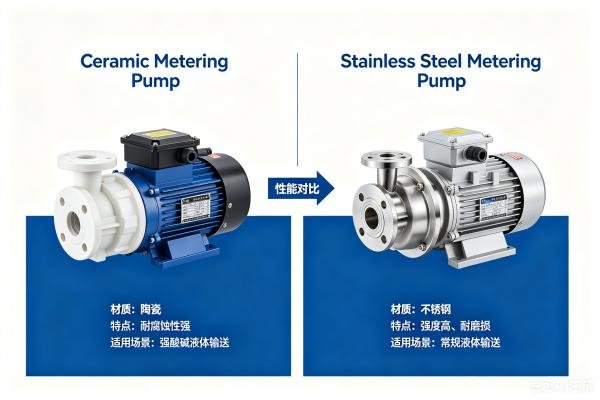
8. Material comparison: Ceramic vs Stainless steel vs PTFE pump head
| Comparison Item | Ceramic Metering Pump | Stainless Steel Metering Pump | PTFE‑lined Pump Head |
|---|---|---|---|
| Strong‑acid / alkali resistance | Excellent | Limited, easy pitting | Good |
| Organic solvent resistance | Excellent | Medium | Risk of swelling & aging |
| Abrasive‑slurry adaptability | Great, high hardness | Medium | Poor, easy lining damage |
| Long‑term metering stability | ±0.1%~±0.5% | Gradual precision decay | General |
| Service life under harsh condition | Long | Short | Medium |
| Metal‑ion contamination risk | Zero | High | Low |
9. Frequently Asked Questions FAQ
Can ceramic metering pumps handle mixed strong acid‑base chemical media?
Ceramic itself resists most acids and alkalis. The key is to select matching sealing materials; avoid hydrofluoric acid and strong hot alkali according to ceramic‑material limits.
How to deal with easy‑crystallization chemical media in chemical workshops?
Flush pump head immediately after shutdown. Perform regular disassembly cleaning; install pre‑filter to reduce crystal‑particle jamming of check valves.
Is ceramic metering pump suitable for 24‑hour continuous chemical‑plant operation?
Yes. Ceramic friction pairs feature low wear rate. Keep proper maintenance and regular seal replacement for long‑term continuous running.
What risks should chemical‑industry users pay attention to for ceramic pumps?
Avoid dry‑running and sharp thermal shock. Hard impact may crack ceramic components. Suction‑side filtration is essential for particle‑containing fluids.
How often shall chemical‑process ceramic metering pumps be calibrated?
For critical chemical‑reaction processes, calibrate every 1‑2 months; for general auxiliary dosing processes, calibrate every 3 months.
Ceramic metering pumps deliver reliable precision dosing for complex and harsh chemical‑industry working conditions. With excellent corrosion resistance, abrasive‑slurry tolerance and low‑contamination performance, they reduce unexpected downtime and cut comprehensive maintenance costs for chemical plants, fine‑chemical factories and pilot‑scale test stations.
Recommend